Over the past year, there’s been a lot of talk in the marketing world about AI “killing” search traffic. Headlines warn that ChatGPT, Perplexity, and Google’s AI Overviews will replace search engines and that websites will lose their organic traffic overnight. But if you zoom out and look at what’s actually happening, the story is a little different.

Search isn’t disappearing. It’s evolving. And it’s being re-monetized.
At our agency, we’ve been watching this shift closely with clients across industries. Over the past year, we’ve started seeing AI referrals appear in analytics reports, while at the same time marketers are worrying about whether AI will replace search entirely. The reality we’re seeing in the data is much more nuanced. AI is changing how people discover information, but it’s not replacing the systems that drive the majority of traffic across the web.
Three recent articles caught my attention and together paint a clearer picture of where things are heading — one about what’s really happening on SERPs, one on ads coming to ChatGPT, and one on content types that get cited in LLMs.
Taken together, they reinforce something we’ve been telling clients for a while: AI isn’t replacing search, it’s reshaping how discovery works online.
The future of discovery isn’t “SEO vs AI.” It’s SEO evolving into GEO (Generative Engine Optimization) alongside a new wave of advertising opportunities.
But before getting into strategy, it helps to ground this conversation in actual usage and traffic data.
AI Traffic Is Real — But Still Tiny Compared to Search
Despite the headlines, AI tools still represent a very small share of total website traffic. Across large datasets of website analytics, the breakdown of traffic sources today looks roughly like this:
| Traffic Source | Share of Website Traffic |
|---|---|
| Organic Search | ~48–50% |
| Direct | ~30% |
| Social | ~6–8% |
| Email & Referral | ~5–7% |
| AI Tools | ~0.1–0.2% |
So despite the headlines, AI isn’t replacing search traffic. At least not yet.
- Organic search continues to be the largest driver of website traffic, with studies consistently showing it generates around half of all website visits.1
- AI referral traffic, on the other hand, is still extremely small. Most research suggests that AI tools currently send well under 1% of total website traffic, though that share is growing quickly.2
In other words: Search currently sends hundreds of times more traffic to websites than AI tools.
That’s an important part of the story, but it can create a false sense of stability. A 0.1–0.2% traffic share sounds negligible, but AI referral traffic didn’t exist as a measurable category two years ago. The trajectory matters as much as the current number. If you’re looking purely at referral traffic today, search remains the dominant discovery engine by a wide margin. But the speed of that shift is worth paying attention to before it shows up more dramatically in your analytics.
Why AI Traffic Share Is Misleading
The reason AI traffic looks so small isn’t because people aren’t using AI. It’s because AI tools answer questions directly instead of sending users to websites. Traditional search is usually more of a research process than a single click. In reality, the process usually looks something like this:
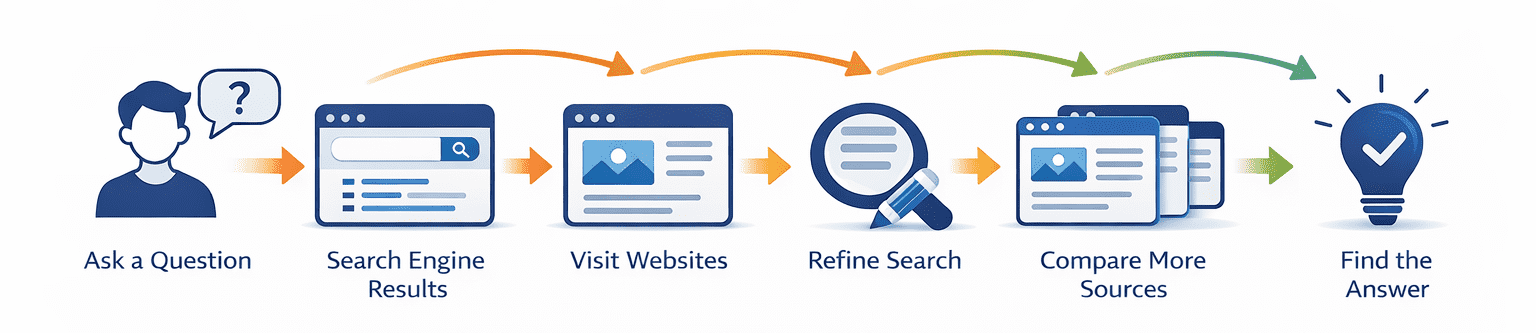
Most people don’t click one link and stop. They explore. Research into search behavior shows that Americans perform about 126 Google searches per month, which averages to roughly four searches per day.3 Those searches often happen in sequences as people refine their questions.
Someone researching a topic might search:
- “best running shoes for beginners”
- “running shoes for flat feet”
- “Brooks vs Hoka running shoes review”
Each query leads to multiple websites, multiple perspectives, and multiple sources before someone feels confident they’ve found the answer. That exploration process is one of the reasons search sends such a large amount of traffic across the web. AI tools compress parts of that journey. Instead of requiring users to piece together information across multiple pages, AI tools pull information from many sources and combine it into a single answer.
So the experience becomes:
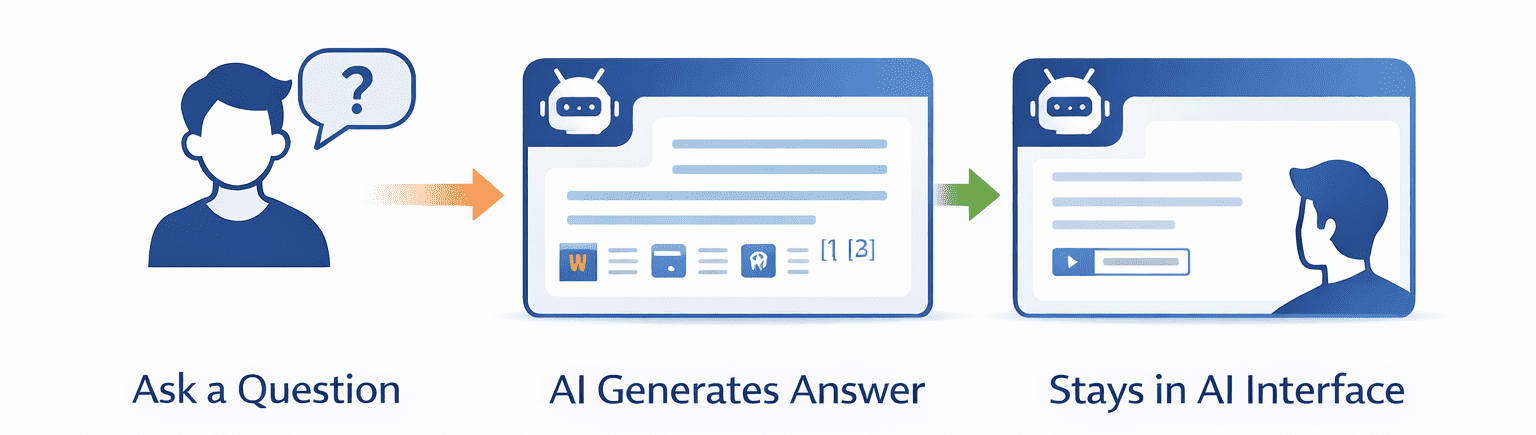
In many cases the AI is still relying on the same sources people would have visited individually through search. The difference is that those sources are now being summarized instead of clicked. That’s why looking only at referral traffic doesn’t tell the full story. AI usage is growing rapidly, but it doesn’t translate into visits in the same way search does.
AI Is Compressing the Research Journey
One way to think about AI tools is that they are compressing the research process, not replacing it. Before AI, answering a complex question often required visiting multiple websites, comparing perspectives, and piecing together information from different sources. Search engines helped you find those sources, but the work of synthesizing the information still fell on the user. And that’s where AI steps in. AI tools pull information from many sources, summarize it, and present a structured answer in seconds. But that answer still depends on the same underlying ecosystem of websites, publishers, experts, and brands creating the original content.
In other words, AI isn’t eliminating the need for content on the web. If anything, it makes clear, authoritative, well-structured information even more important.
For marketers, that means the goal is no longer just to rank. It’s to ensure your brand’s expertise and content are part of the information layer that AI systems rely on to generate answers.
AI Usage Is Growing Fast — But Search Is Still Massive
When you look at how often people use these tools, the scale becomes clearer. Google processes roughly 8.5–14 billion searches per day, depending on the methodology used to estimate search volume.4 ChatGPT, by comparison, is estimated to handle roughly 1.5–2.5 billion prompts per day.5 Depending on the estimate, that means ChatGPT’s total query volume is somewhere around 10–18% of Google’s daily search volume.
That’s significant growth.
But search still operates at an entirely different scale. Another large study comparing platform usage found:
| Platform | Annual Visits |
|---|---|
| Search Engines | ~1.86 trillion |
| AI Chatbots | ~55 billion |
That means search engines receive roughly 30–35× more visits than AI chatbots.6
Even with rapid growth, AI discovery is still a relatively small part of the overall discovery ecosystem today. But the pace of that growth is worth noting: search engines took decades to reach their current scale. AI tools have reached tens of billions of annual visits in just a few years. It’s clearly big enough to matter now, and the gap is narrowing faster than the current numbers alone suggest.
GEO: The Next Layer of SEO
This is where Generative Engine Optimization (GEO) comes in. GEO isn’t replacing SEO. It’s extending it, but with some important differences worth understanding.
Research from Onely7 suggests that certain types of content are more likely to be referenced in AI responses, including:
- Glossaries and definitions
- Structured educational content
- How-to guides
- Authoritative reference pages
At first glance, that list looks a lot like good SEO content, and it is. But the research also points to a structural difference in what AI systems actually reward. Traditional SEO success is driven largely by domain authority, backlinks, and ranking position. AI citation success appears to be driven more by content architecture: how well your content is structured for extraction, whether it includes comparison tables or FAQ schema, whether your authors are clearly credentialed, and whether your brand is mentioned and recognized as an entity across the web. In the Onely data, domain authority showed a weak negative correlation with AI citation rates. Brand mentions and knowledge graph alignment were far stronger predictors.
That doesn’t mean strong SEO content is the wrong starting point — it usually is the right one. But it does mean GEO optimization sometimes requires deliberate structural changes that go beyond what traditional SEO alone demands.
We’ve already started helping clients think about how their content performs not just in search rankings, but also inside AI-generated answers. The fundamentals, clear structure, authoritative expertise, and helpful educational content, still matter in both contexts. But we’re now thinking differently about things like content extractability, author attribution, and brand entity presence — not as new concepts, but as signals that carry more weight in an AI-driven discovery context than they did before.
Meanwhile, Search Results Are Being Re-Monetized
While everyone is focused on AI taking traffic from publishers, something else is happening quietly inside search results. As Aleyda Solis recently pointed out, search engine results pages are shifting again, and ads are becoming more prominent.8 AI answers now occupy significant space at the top of many results pages. Organic listings often appear further down.
But one thing hasn’t moved: ads.
If anything, they’ve become even more visible and actionable within the new layout (and often harder to identify as ads). That means the traditional balance between organic discovery and paid discovery may actually tilt more toward advertising revenue as AI answers expand.
And Yes — Ads Are Coming to AI
This monetization trend isn’t limited to search engines. The Verge recently reported that OpenAI is testing advertising inside ChatGPT.9 That shouldn’t surprise anyone who has watched how digital platforms evolve.
Every major discovery platform eventually develops an ad model:
- Search engines
- Social media
- Marketplaces
- Streaming platforms
AI assistants will likely follow the same path. The real question isn’t whether ads will appear inside AI tools. It’s how seamlessly they will be integrated into the experience.
The Next Chapter of Digital Discovery
If you look back over the past 25 years of the internet, discovery has constantly evolved. In the early days, people navigated the web through directories and portals like Yahoo and DMOZ. Then search engines organized the internet around keywords and links. Social media introduced a new layer of discovery driven by algorithms and feeds. Now we’re entering the next phase: AI-powered answers.
Each shift changed how people found information, but none of them eliminated the need for high-quality content or trusted sources. Instead, they changed how that content was surfaced and monetized. AI is doing the same thing.
It’s compressing the research process, reshaping how answers are delivered, and opening up new opportunities for both organic visibility and advertising.
For marketers, the challenge isn’t to chase hype or panic about the end of search. But it’s also not to wait until the shift is obvious in the data — by then, the window to position early has closed. The real opportunity is to understand how discovery is evolving now, and build visibility in both the interfaces that dominate today and the ones that are growing fast enough to matter tomorrow.
Because no matter how the interface changes, one thing hasn’t changed: the internet still runs on information.
And the organizations that create the most useful, authoritative information will continue to shape how people find answers.
- BrightEdge Research – Organic search drives ~53% of website traffic
https://www.brightedge.com/resources/webinars/organic-search-drives-more-than-50-percent-of-website-traffic ↩︎ - RankScience analysis of AI vs search referral traffic
https://www.rankscience.com/blog/ai-search-vs-google-traffic-data ↩︎ - Search Engine Land reporting on Google search frequency
https://searchengineland.com/126-google-searches-per-month-452972 ↩︎ - Exploding Topics analysis of Google search volume
https://explodingtopics.com/blog/google-searches-per-day ↩︎ - TechRadar reporting on ChatGPT prompt volume
https://www.techradar.com/computing/artificial-intelligence/chatgpt-users-now-send-2-5-billion-prompts-a-day ↩︎ - IntelligentHQ study comparing AI chatbot and search platform visits
https://www.intelligenthq.com/ai-chatbots-growth-search-engines-dominance ↩︎ - Content Types & Formats That Earn Mentions in LLMs
https://www.onely.com/blog/content-types-that-earn-mentions-in-llms/ ↩︎ - Aleyda Solis – SERP monetization shifts
https://www.aleydasolis.com/en/search-engine-optimization/serp-shifts-ads-remonetized ↩︎ - The Verge – OpenAI testing ads in ChatGPT
https://www.theverge.com/ai-artificial-intelligence/876029/openai-testing-ads-in-chatgpt ↩︎